


LSU’s Coastal Roots Program Grows Solutions for Louisiana and its Students
April 20, 2026
Louisiana continues to face many environmental challenges, from wetlands and habitats disappearing to coastal erosion and flooding becoming more prominent across the state. In flat cities like Baton Rouge, the grass does not absorb much water, support wildlife, or effectively prevent flooding. Unfortunately, students often encounter these challenges only in the classroom, without opportunities to engage with real-world solutions or see how they can make a meaningful impact.
LSU’s Coastal Roots program is working to change both.
Video by Callie Boyd
For more than 25 years, the program has connected students directly to environmental restoration by turning science lessons into hands-on action. Students spend the school year growing native trees or grasses and caring for them. At the end of the year, students go on field trips to plant the trees or grasses in locations such as parks, coastal areas, and wildlife refuges, contributing to restoration efforts across Louisiana. Initially, the program had to buy trees to plant in restoration areas, but the cost was so high they had to come up with a different plan.
“I thought, well, why couldn’t we do this where the students grew their own trees?” said Pamela Blanchard, Coastal Roots co-director and associate professor at the LSU Lutrill & Pearl Payne School of Education. “And so, after that, it turned into Coastal Roots.”
The project is built on partnerships. A partnership between LSU, local schools, Baton Rouge Enhancement Commission (BREC parks), and state and federal agencies, the program has grown into a statewide effort. Students are not only learning about environmental issues, but they are also actively working to solve them. Without these partnerships, students would have no land to make this possible.
Since its launch, more than 35,000 students have participated in Coastal Roots, and the program is approaching 250,000 trees planted. Those numbers translate into both environmental progress and personal growth.
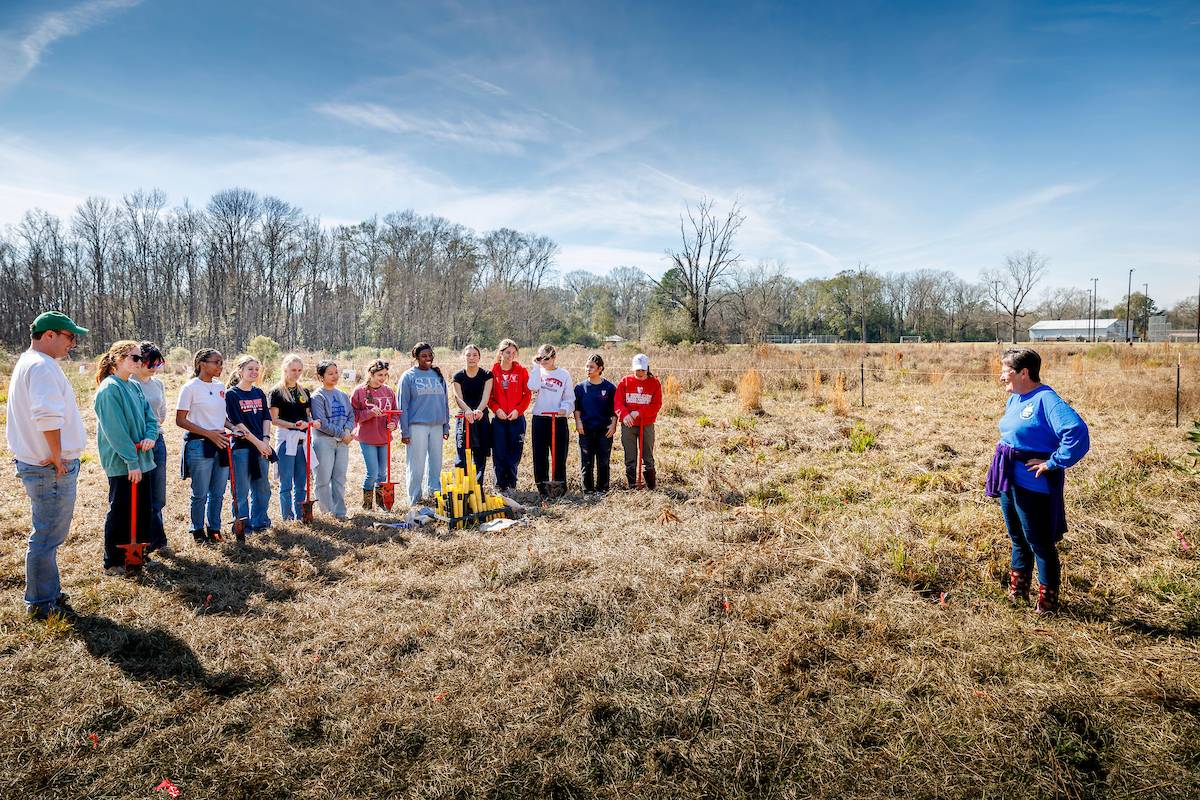
Pamela Blanchard, Coastal Roots co-director, speaks with students from St. Joseph's Academy.
– Photos by Eddy Perez
“We’re starting to see those students come back to us that have continued interest in the coast,” said Dani DiIullo of Louisiana Sea Grant.
For students, it is important that the impact is something they can see.
“I can really see the progress that we’re doing here. It is really rewarding,” said St. Joseph’s Academy student Madison Rembo.
The trees planted through Coastal Roots have deeper roots than grass and absorb more water. In turn, this slows water build-up, reduces flooding, and traps carbon in the air, creating less pollution. This turns this flat, unused land into a layered ecosystem.
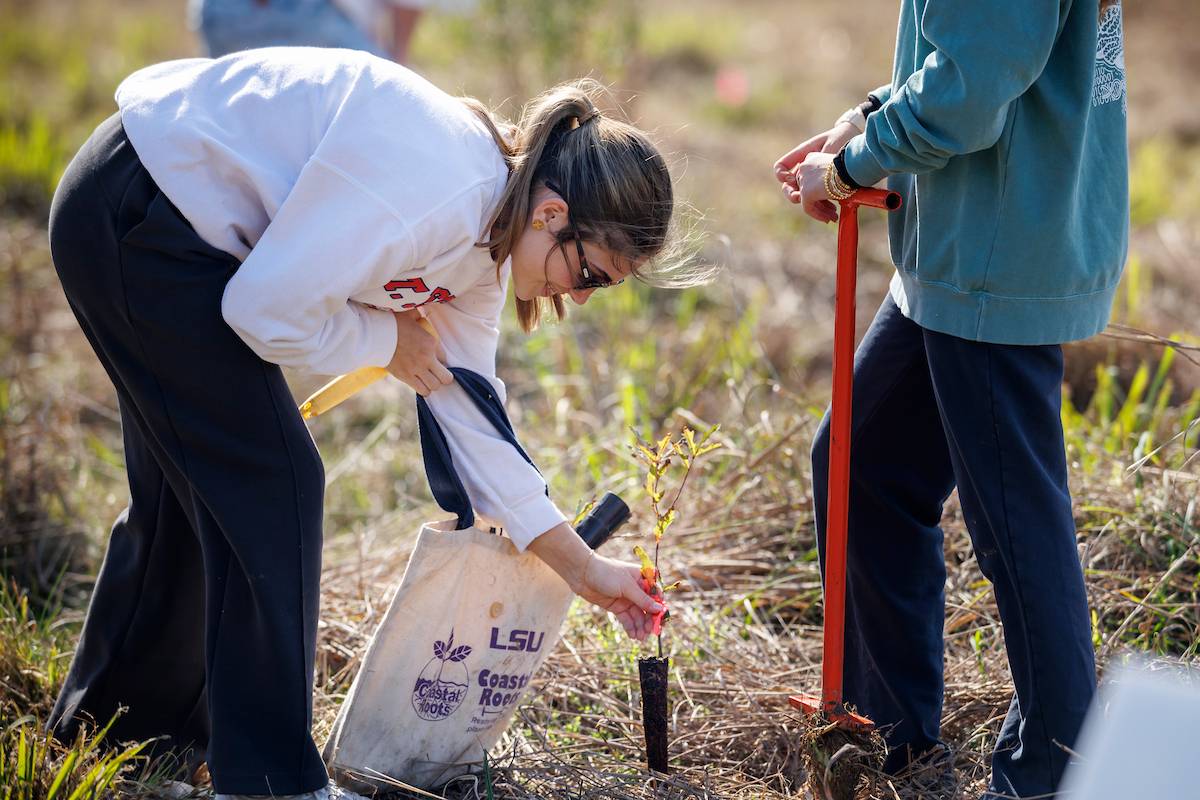
Since its launch, more than 35,000 students have participated in Coastal Roots, and the program is approaching 250,000 trees planted.
“By planting, we’re reforesting these mowed sections,” said Lydia Nichols Russell, a natural resources manager with BREC. “That helps with flood mitigation but also creates natural habitat for our wildlife.”
The program impacts more than just environmental restoration; students learn responsibility by caring for their trees year-round and gain an understanding of how small actions can make a huge difference. For many, it also opens their eyes to future careers and their role in protecting Louisiana’s coast.
“Our students have learned a lot of responsibility in honoring their commitments and how we can help our community improve the environment,” said Sarah Catherine Buie, a science teacher at St. Joseph’s Academy.
As Louisiana continues to navigate environmental challenges, Coastal Roots offers a clear solution. One that starts in the classroom but extends far beyond it. By combining education, partnerships, and hands-on restoration, the program is not only restoring Louisiana but giving students a purpose to show real long-term solutions in their communities.
“I really hope that students take away the idea that they can make a difference,” Blanchard said. “That every small act of stewardship adds up over time.”